

🇦🇹 Thomas Heinzle, Federal Ministry of Innovation, Mobility and Infrastructure (BMIMI): passenger rail transport in Austria
🇦🇹 Thomas Heinzle, Federal Ministry of Innovation, Mobility and Infrastructure (BMIMI): passenger rail transport in Austria
Austria’s Federal Ministry of Innovation, Mobility and Infrastructure (Bundesministerium für Innovation, Mobilität und Infrastruktur, BMIMI) manages transport by land, air, water and rail, as well as promoting research and innovative technologies. It is divided into four Directorate Generals: Executive Committee and International Affairs, Mobility, Innovation and Technology, and Transport.
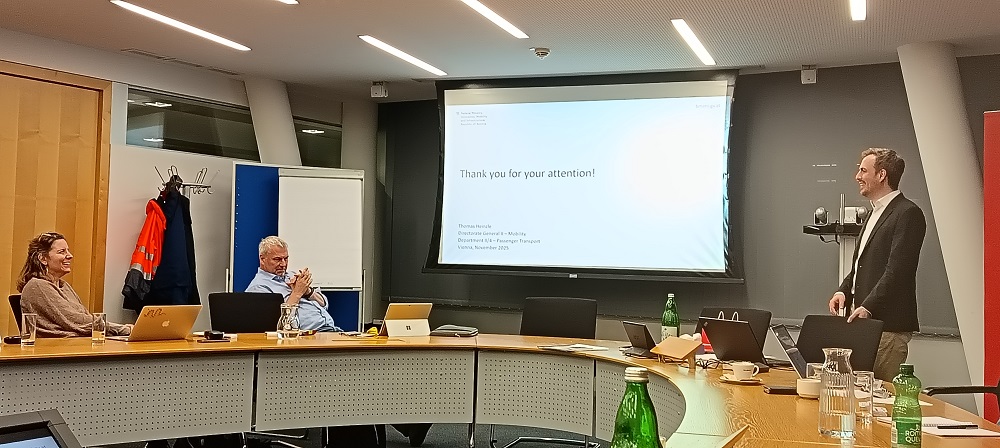
During Futura-Mobility’s field trip to Austria in November 2025, the delegation met with Thomas Heinzle, from BMIMI’s Directorate General II – Mobility, for an enlightening presentation and discussion on passenger rail transport.
Futura-Mobility: Could you explain the planning principle of Austria’s integrated clock-face timetable?
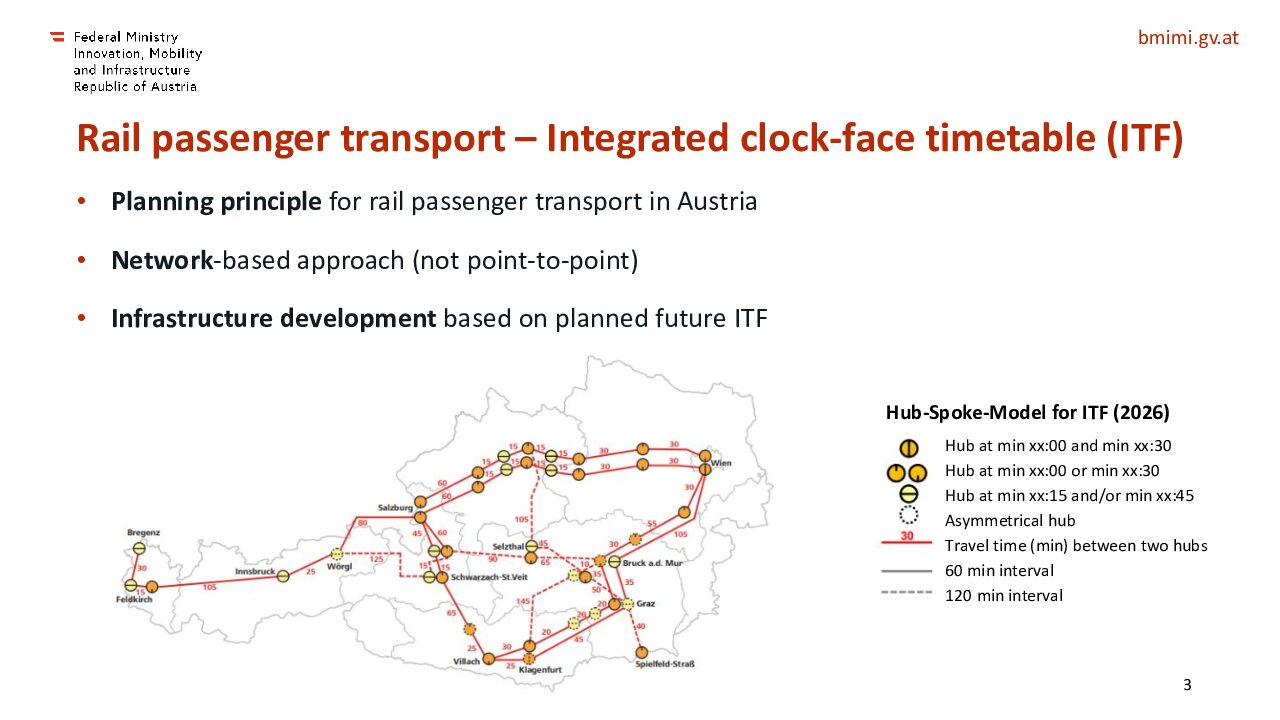
Thomas Heinzle: In Austria, both local/regional and most long-distance passenger trains are based on the principle of the integrated clock-face timetable (ITF).
ITF means that all trains run at fixed and regular intervals, e.g. every 30 or 60 minutes, and that trains from all directions arrive and depart at transfer stations, so called hubs, every (half) hour throughout the day shortly before or after minute 15, 30, 45 and/or 60. And these fixed times are integrated since they are set with connections to other trains in mind, hence passengers are guaranteed seamless transfers. This approach puts the focus on providing optimal connections between trains from different directions to enable quick journeys not only for direct connections, but also for transfer connections. The core structure of the timetables is fixed for the long term e.g. already up until 2040! This approach differs from in France with the TGV, for instance, where the aim is to get from city A to city B as fast as possible, without taking into account possible connections to other trains.
The ITF is also the planning principle for rail infrastructure. Since the core structure of the rail service timetable for 2040 has already been drawn up, the capacity needed for every service on the network – how many long-distance trains, how many freight trains, etc. – has already been established. Based on this information, we plan and build infrastructure accordingly.
FM: Rail passengers in Austria can buy a ‘KlimaTicket’: could you explain how it works?
TH: In 2021, the State of Austria introduced the annual KlimaTicket Austria, which covers all public transport in the country, e.g. any bus or tram in any city, any long- or short-distance train (with very few exceptions, such as the CAT city airport train in Vienna). No reservation is required. Currently around 300,000 people use this ticket, representing around 3% of the population of Austria.
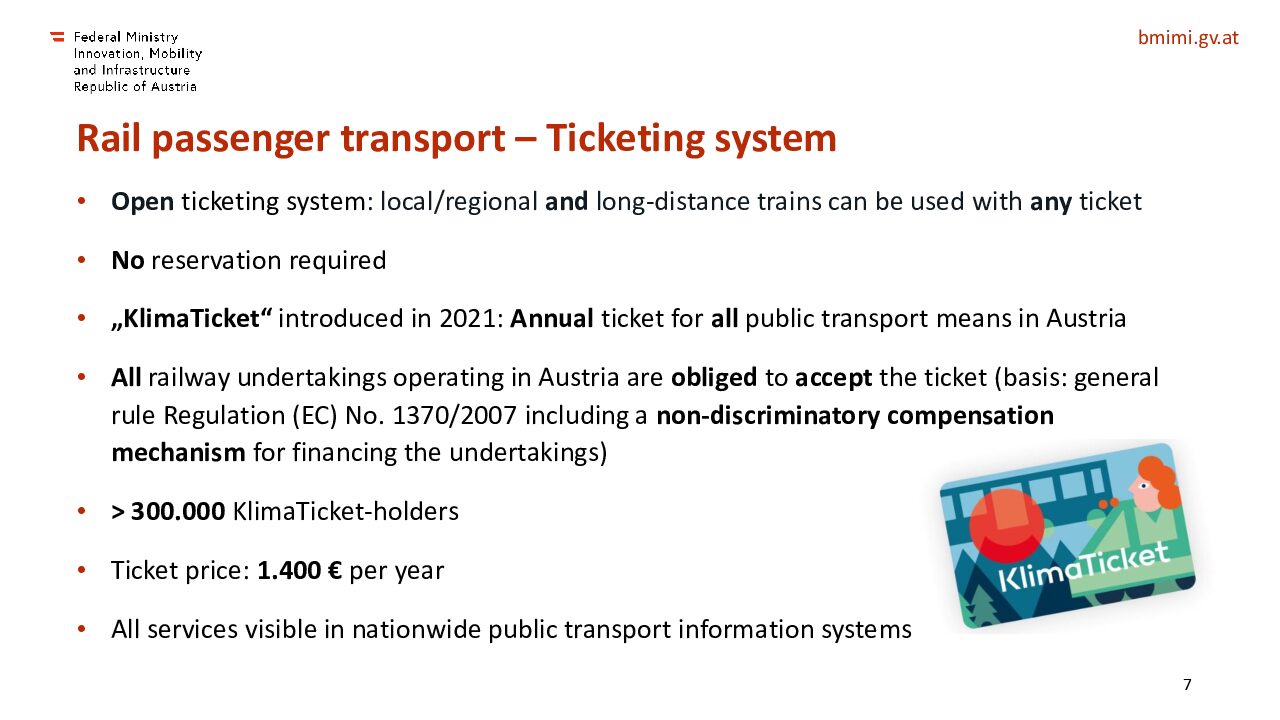
Additionally, there are annual KlimaTickets for the regions. Around 1.4 million people (around 15% of the population of Austria) have one of these annual regional tickets.
The KlimaTicket Austria currently costs 1,400 euros a year. And the regional annual tickets between 400 and 700 euros annually depending on the region, since they differ in geographical size.
From the customer perspective, having one ticket that includes all public transport means makes travelling much simpler. From a policy perspective, offering these cheap tickets is a means of encouraging Austrians to change their mobility behaviour, to use trains and public transport not only for work trips but for leisure too. Demand for the nationwide KlimaTicket has been steadily increasing over the years. But so far, despite this popularity, its use has not led to a significant shift away from cars to trains and public transport.
All railway operators running services in Austria are obliged to accept the KlimaTicket, in line with Regulation (EC) No. 1370/2007, which includes a non-discriminatory compensation mechanism for financing the services they provide that are used with this ticket.
FM: How do the Public Service Obligation (PSO) services and commercial services function?
TH: All local and regional trains in Austria are financed by PSO contracts. Long-distance rail is partially provided commercially, i.e. all the costs are covered by ticket revenue, and partially financed by PSO contracts. For instance, rail services running across Austria east to west from Vienna to Linz and Salzburg are provided commercially, since these journey times by train are faster than by car so generate sufficient demand.
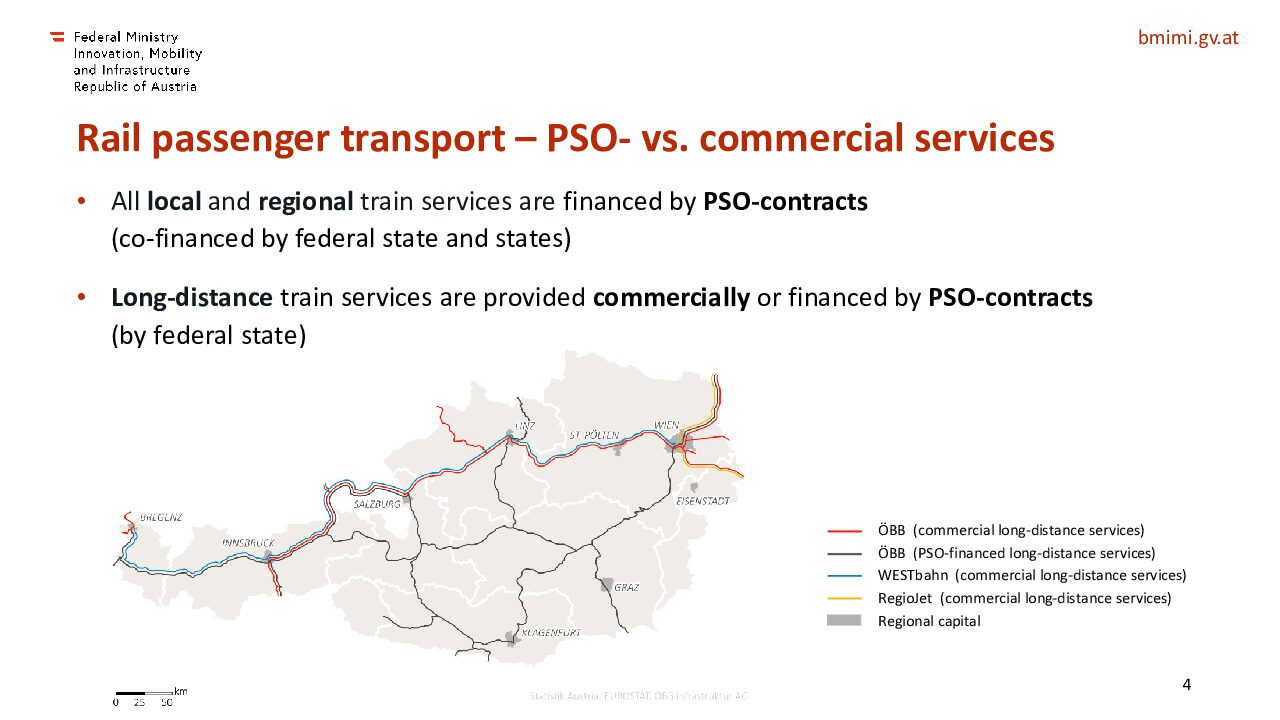
There are several reasons why, up until now, commercial rail services only run east-west in Austria.
The country has always had strong ties, economic and through a shared language, with Germany. This explains why development of rail infrastructure in the 1980s and 90s was largely driven by the desire to travel fast from Vienna to Germany. The line from Vienna to Linz was rebuilt and now has four tracks and operating speeds of 200 to 250km/hr. Its rail passenger services are commercial because it has high capacity and high speeds, making travel times comparable or even faster than by car.
Secondly, Austria only has one big city, Vienna, with a population of around two million, followed by Graz, which has around 300,000 inhabitants. The population of Linz, Salzburg and Innsbruck combined is around 500,000. Commercial passenger rail services are only viable between big cities where there is sufficient demand and where there are attractive travel times compared to the car.
In December 2025, a new high-speed line, the so-called Koralmbahn, is opening between the cities of Graz and Klagenfurt, in the south of Austria, reducing the travel time between the two cities to about 45 minutes. In 2030, another high-speed section between Vienna and Graz, the so-called Semmering Base Tunnel, will be opened, reducing the travel time between the two cities by about 30 minutes . Since travel times by train will henceforth be significantly reduced compared to the car, in five to ten years, there is likely to be significant higher demand for passenger rail operating between the north and south of the country. Maybe these new lines will be operated commercially then, but it is too soon to take a decision.
We only have one PSO contract for all long-distance day and night trains in Austria. It is directly awarded to the state-owned operator ÖBB-PV AG, most recently in 2020, by SCHIG mbH, a private company and 100% subsidiary of BMIMI. SCHIG serves as a one-stop-shop for the provinces and the state to pay for rail services: they both transfer money to SCHIG, which then pays ÖBB.
For regional trains, there is a separate PSO contract for each province. Additional contracts also exist, here and there, for smaller railway companies operating at regional level.
ÖBB, which is 100% state-owned, does tend to be the operator of choice for the country’s passenger rail, but in some regions, because of historical reasons, there are small operators. In the southwest of Styria, for instance, there is a region that has a separate contract.
FM: In line with EU legislation, surely it is mandatory to open up passenger rail services to OBB’s competitors?
TH: Yes. Austria opened up its passenger services in 1998 for operators based in the country. Then in 2016 for any EU railway operator providing rail passenger services. This means that any EU railway operator can freely operate commercial passenger train services on the Austrian rail network.
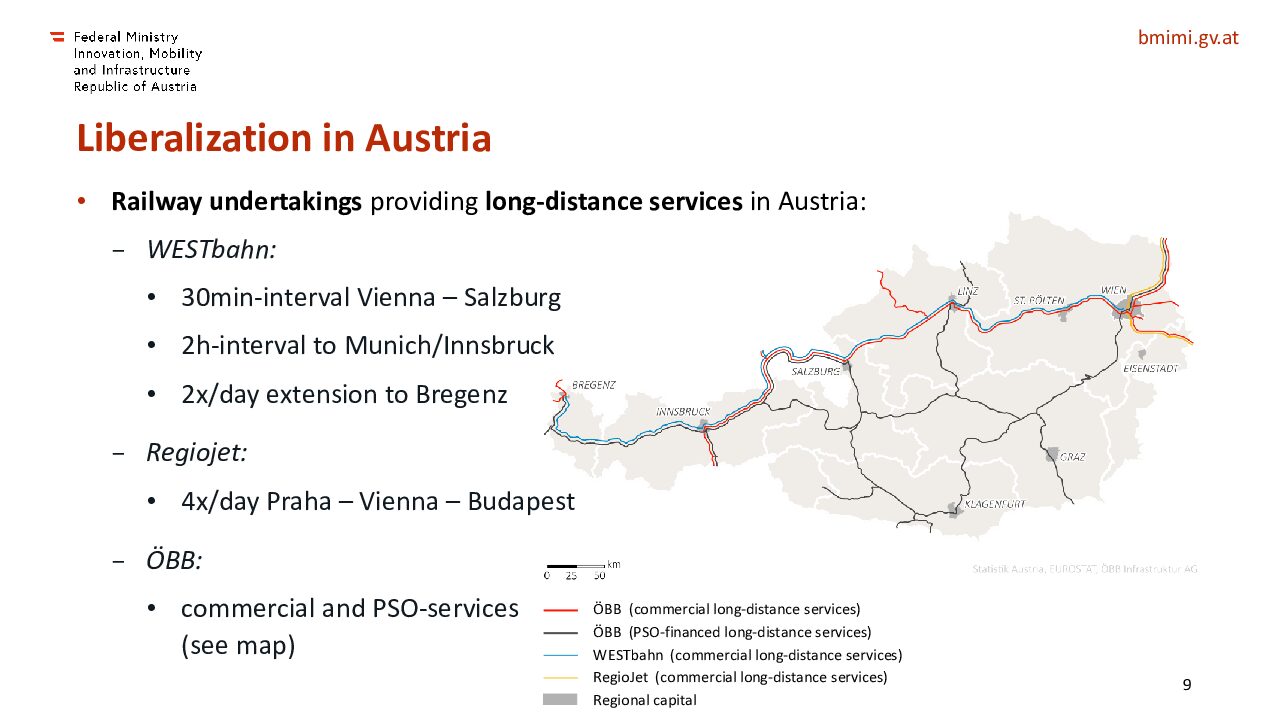
Today we have three companies running passenger rail services in Austria. In addition to ÖBB with commercial and PSO contracts, we have the Austrian WESTbahn and the Czech RegioJet currently providing long-distance services on a commercial base only.
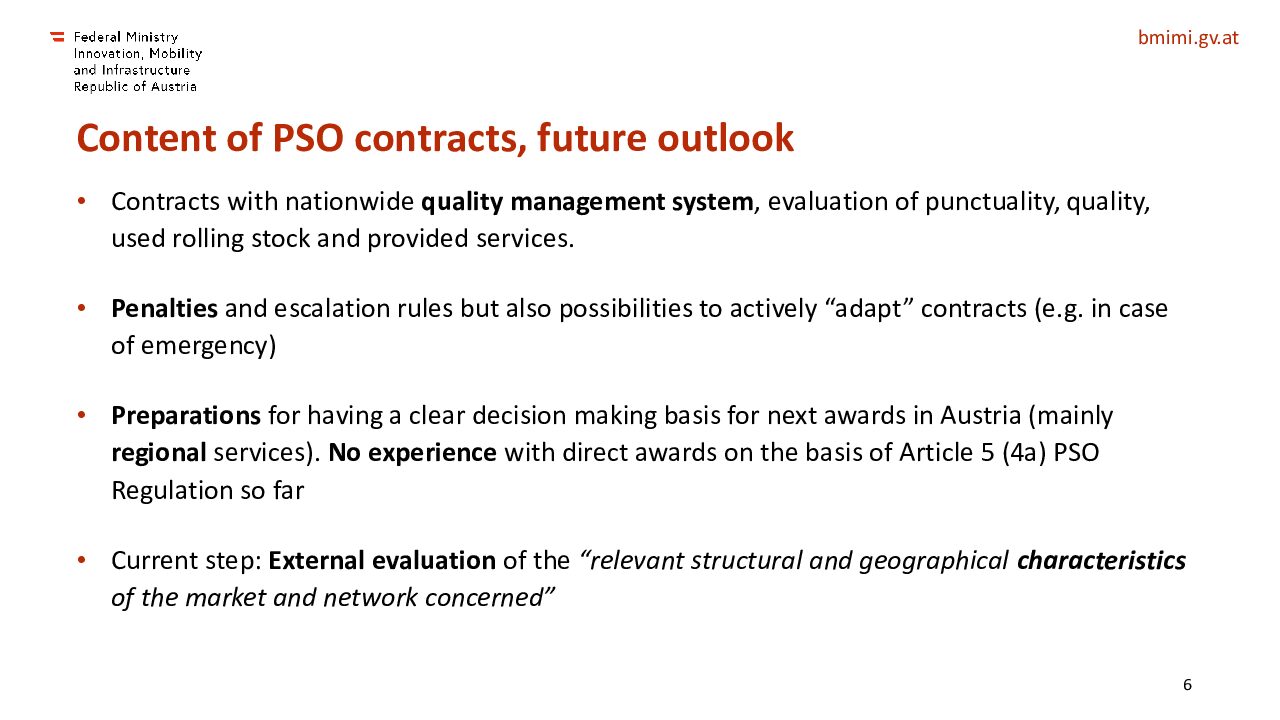
Up until the end of 2023 in the European Union, it was possible for the authorities of member states to directly award PSO contracts or open them to tender. Since the amended (EU) 2016/2338) regulation came into force, it has become more complicated to directly award, but it is still legally possible, unless prohibited by national law. The regulation now stipulates PSO contracts can only be directly awarded if ‘the relevant structural and geographical characteristics of the market and network are specific’.
Since BMIMI is keen to continue directly awarding PSO contracts for regional services, it is awaiting the results of an external assessment of Austria’s passenger rail ‘market and network characteristics’ to see if they qualify as ‘specific’. The definition of ‘characteristics’ is extremely general and open to much interpretation. For instance, it might concern an extremely isolated network, or rolling stock, e.g. because of the lack of an electricity supply or the height of station platforms, only a certain type of train can be used.
Germany does things quite differently. All regional trains are tendered out and have been since 1994. We have observed that at the beginning the costs were significantly reduced, but today, there is often just one operator bidding for a tender. Also, some operators go bankrupt during their contracts, which is a big issue because in this case, how do you guarantee services for passengers?
On this point, BMIMI has good insight on ÖBB’s operating costs, not only the total costs, but also for each component, like personnel, energy or maintenance, for instance. Also, together with consultants, we compare these costs with those in Germany. Our findings reveal that while Germany has rail competition (open tendering) for its regional passenger rail services and Austria doesn’t, the costs are very similar. This reference reassures us we are on the right path with our direct award approach.
FM: How has open access impacted the passenger rail service offering in Austria?
TH: Today, ÖBB and WESTbahn are both operating long distance trains on the routes between Vienna and Innsbruck. The ÖBB trains run at least every hour, the WESTbahn trains every two hours or less. However, these frequencies may change in the years to come, depending on passenger demand.
WESTbahn’s entry on ÖBB’s routes did cause some disruption and challenges with the ITF timetable. There were many court cases over the awarding of PSO awards, track access regulations, and so forth. On the upside, the competition led to better prices and service quality e.g. on-board Wi-Fi for passengers on all trains since WESTbahn started operating.
It is also worth mentioning that right now, on ÖBB’s ticketing platform, it is only possible to book train and bus tickets for services run by ÖBB. Train services provided by WESTbahn and RegioJet are simply displayed on the online timetable, together with their connections.
In Austria, a quality management (and incentive) system in place tracks every PSO-financed train to monitor its punctuality at every station. Furthermore, a team of several people is constantly travelling on the trains around the country with a checklist on service elements like cleanliness, signage in the right place, intelligible loudspeaker announcements, and so forth. Based on all these findings, the operator either receives a bonus or a fine. So this system functions as an incentive to encourage all our rail operators providing PSO-services to constantly improve.
FM: Have you identified any particular challenges for passenger rail in Austria?
TH: Yes, there are two areas we are really focusing on right now: how to guarantee perfect rail service connections, based on the ITF principle, and how to include all the ticketing offers from all the operators on a fully integrated and neutral, ticket booking platform.