


🤖 Artificial Intelligence: geoeconomic and geopolitical perspectives
🤖 Artificial Intelligence: geoeconomic and geopolitical perspectives
Economic performance, production methods, global power dynamics, future prospects… This conference, on 2 April in Paris, organised by the Institute for International and Strategic Relations (IRIS) and NEOMA Business School, explored the challenges of this technology reshaping the world of work.
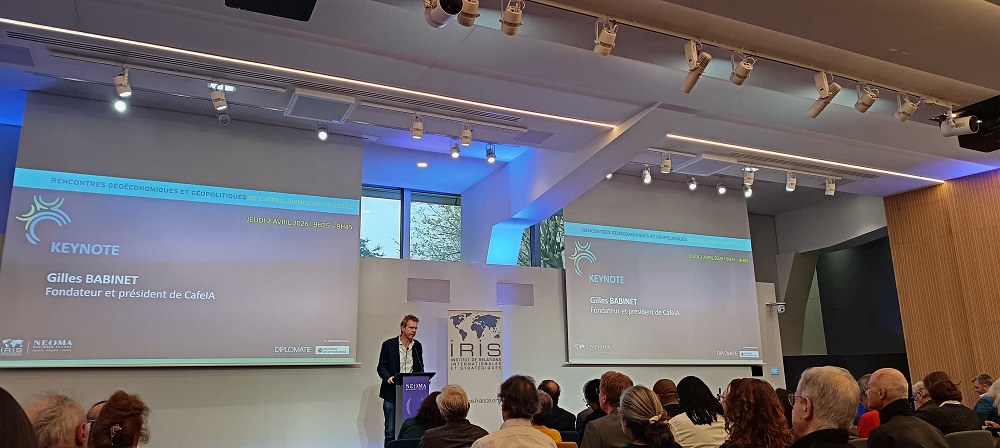
Artificial intelligence (AI) may not a new technology — its origins date back to Alan Turing’s work in the 1950s. Yet the current wave stands out because use of the technology in both private and professional life is speeding up fast, accompanied by a worrying loss of control. Controversy over Grok, the AI chatbot on Elon Musk’s X platform. Growing concerns over the potentially harmful impacts of AI chatbots in general on vulnerable users. Both illustrate the kinds of risks humans face when dealing with AI without safeguards.
Gilles Babinet, founder and president of CaféIA, a French initiative promoting inclusion and debate on AI issues, explains how this AI race is being largely driven by the prospect of exponential AI: an AI that could better itself and eventually surpass human capabilities in all fields. “This possibility is still a gamble, though! Whoever controls exponential AI will control the world.” Is the United States (US) taking this gamble? In any case, right now it is largely in favour of an unregulated (‘unchecked’) approach to AI, one which allows the technology to advance faster.
In this highly competitive context, the US and China are now looking to gain full control over the AI value chain, from semiconductors to the development of machine learning models, and including computing infrastructure.
“In addition to dominating rare earths – vital for AI – China has made spectacular progress since 2010 and now leads the world in AI patent filings,” explains Charles Thibout, senior lecturer in political science (Sciences Po Strasbourg, SAGE) and associate researcher at IRIS. “China’s real industrial policy to catch up with the US also involves a great deal of research and mobilising Chinese giants like Alibaba,” he adds. DeepSeek, China’s open and simple AI model, earmarked for emerging countries, represents an additional weapon in this technological battle.
Philippe Barbet, professor emeritus of economics at Sorbonne Paris Nord University and research fellow at IRIS, describes the US’ overwhelming dominance across the entire value chain, from chips (Nvidia, Intel) to cloud data (Amazon, Microsoft, Google), and including generative AI models like Gemini, Grok, OpenAI, and Anthropic.
According to Mr Barbet, the scarcity of new entrants, a defining feature of today’s AI market, reflects the closed nature of the landscape. “It’s extremely locked in,” he says. “Everyone is watching closely, since powerful positions are forming in AI. Early entrants stand to gain significantly from ‘path dependence’.”
Lagging two years behind the US and China in terms of competitiveness and technology, Europe had, up until now, seemed content to position itself as the AI ‘regulator’, or ‘referee’. However, the €200 billion AI investment plan, announced in February 2026, suggests it wants to get back in the running. “Referees don’t win matches,” points out Philippe Barbet. “Europe must shift from being a mere regulator to a credible industrial player, despite a gap that will be difficult to bridge, most likely by opting for an alternative model to that of the US.”
A transition from referee to player. Mr Babinet recommends Europe adopt an integrated, standardised and regulated model. He would like to see AI integrated into business applications to run natively where the work is actually carried out. Such an approach would mirror that adopted by the automotive industry in France in its early days, he points out. Indeed, in the years following the Second World War, this sector structured its operations around the standardisation of vehicle models and assembly lines, thereby laying the vital foundations for a productivity boom.
Sovereignty in the field of AI must not be synonymous with isolation, warns Alain Goudey, deputy director general for Digital at NEOMA Business School. Instead, he describes it as the ability to “retain control over one’s dependencies”. He also calls for “European intellectual sovereignty”, drawing on cutting-edge European models (that push the current boundaries of AI capabilities) like Mistral AI or EU GPT.
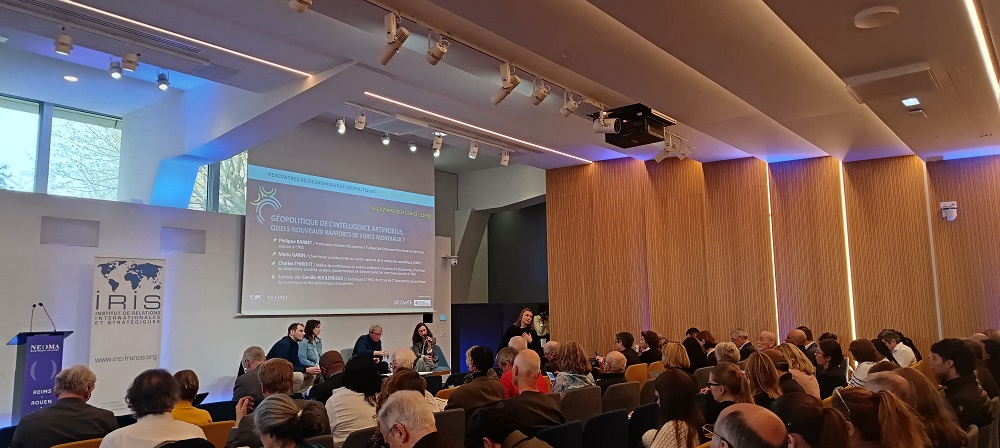
Business: how to integrate and use AI?
In this climate of fierce international competition, AI is bringing about profound changes to business models and production methods. This technology is now the “new grammar of economic performance”, reckons Mr Goudey. “It is transforming decision making and innovation within companies.” “This transformation affects both internal operations and customer relations,” adds Laurent Boyer, director of Business Development at the sales channel Europe AlloIA.
AI technology is constantly evolving and has yet to reach maturity (will it ever?). Alain Goudey therefore advises companies to adopt a ‘portfolio strategy’ so as not to put all their eggs in one basket, driven by a top-down corporate vision. At the same time, it is necessary to also take into account the major shift AI is also bringing about on the web: whereas SEO (search engine optimisation) focused on content visibility, generative AI tools are based on a different criterion: content selectability. This underlines the importance henceforth of optimising content to improve its chances of being selected. “Companies need to start thinking carefully about how they appear in AI searches,” advises Mr Goudey. This means monitoring their business image and information about their activity circulating on the web. “Companies need to be understood, trusted, and read by these AI tools,” sums up Mr Laurent.
In the field, when it comes to productivity, Claire Mathieu, director of Data & AI at Suez Group, explains how AI has become a strategic tool for tackling three major challenges: water scarcity, the impacts of climate change on infrastructure, and ageing infrastructure. “Faced with these increasingly complex issues, AI is helping us and is becoming increasingly indispensable, especially for predictive tasks.” For example, AI optimises water consumption at treatment plants and predicts pipe bursts. “With drones and cameras, the technology also gives us eyes and ears where we didn’t have them before,” she adds.
AI appeals because it enables time savings. But for whom and how? “Gaining time doesn’t automatically mean gains in efficiency!” warns Mr Boyer. “You shouldn’t use AI just anywhere or everywhere!” Indeed, using AI might save time for one individual within a company, but not necessarily for everyone. This view is shared by Mr Goudey, who insists on analysing the various types of operational efficiency gains made possible by AI (full automation, co-intelligence, decision-making, etc), all the while bearing in mind that “speed isn’t always a source of efficiency”.
“Right now we’re achieving gains with AI in [operational performance] in our core business, but not in our internal operations,” adds Ms Mathieu from Suez Group.
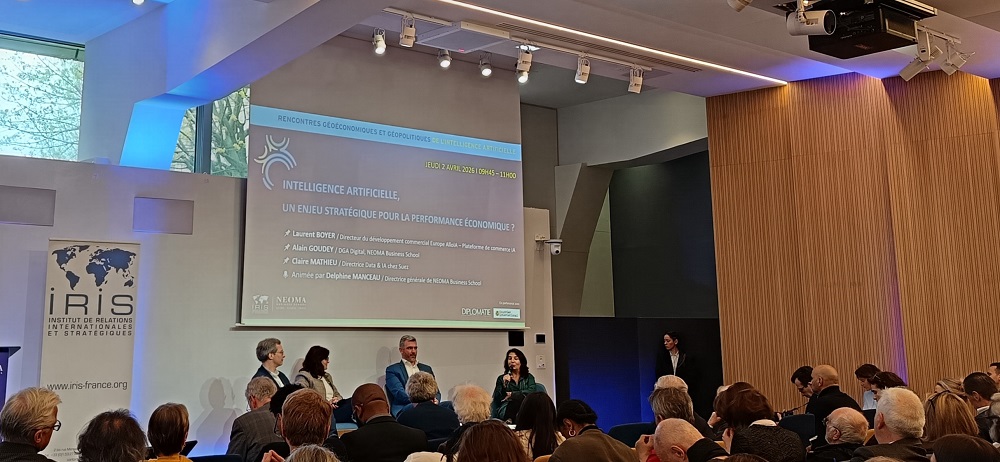
Betting on data centres
Europe, is seeing a surge in the number of data centres (also known as ‘AI factories’ i.e. data centres dedicated to AI) being planned or built to meet the (anticipated) immense computing demands of AI tools. Today, France ranks third in Europe, behind the U.K. and Germany, for this infrastructure.
Although data centres are often presented as a boon for regional attractiveness and national sovereignty, building them poses questions over their current and future impacts in terms of land use (sealing, loss of agricultural use, impacts on biodiversity), water and energy consumption, and employment.
These concerns are all the more valid given this race to launch projects is based on an colossal bet! After all, user demand for AI remains as yet unknown. “In any case, for the time being, existing data centres are underused,” points out Marie Garin, a postdoctoral researcher at the French National Centre for Scientific Research (CNRS). She compares today’s ‘uncharted territory’ of data centres to the gamble taken on railway lines in the US between 1880 and 1893: notably because the technology was so new and huge capital was needed, railway owners often made more money from construction, land and mining rights than from operating the tracks themselves.
‘Stargate’, the US project to invest massively in data centres, is raising concerns over the risk of further strengthening the AI dominance of big companies, and also over sustainability in terms of energy consumption. In France, in order to take control of its infrastructure, the French company Mistral AI is raising funds to build its own giant data centre. However, the site, located in the Paris region, is being called into question over its environmental impact (consumption of electricity and water).
Unease over energy consumption has even led to some projects being scrapped or reviewed. In 2024, Dublin rejected plans for a Google data centre on the grounds the project failed to incorporate renewable energy and would put pressure on Ireland’s national grid. In 2026, the British government even acknowledged it had made a mistake in approving development of a 72,000-square-metre site in Buckinghamshire (south-east England), given its impacts on the environment and local energy grid.
Social choice
Never underestimate the lobbying power of big tech companies (Google, Amazon, Facebook, Apple, Microsoft, etc.) either! They have huge clout when comes to delaying or influencing regulation, or shaping political perceptions of their technologies, including AI. Indeed in 2025, these giants had 890 lobbyists in Brussels – more than all the Members of the European Parliament (MEP) put together!
However, despite this pressure, the tide seems to be turning towards accountability. In 2025, Mistral AI published a groundbreaking study quantifying the environmental impacts of its large language models (LLM), becoming the first company in the sector to shed light on this hidden aspect of AI. More recently, in 2026, the European Uninon (EU) reacted swiftly to the Grok controversy (over the generation of sexual deepfake images) by pushing for a ban on AI services that allow people to be ‘stripped naked’ without their consent.
There are plenty other ‘invisible’ aspects of AI. Marie Garin points out the hidden reality of precarious employment, with workers, often living in emerging economies, exposed to violent and extreme content in order to train algorithms. Given this reality, she even questions use of the word ‘intelligence’ in AI, “which obscures the human beings behind the machine.”
One thing is sure: AI is presenting us with social choice. Tomorrow’s world will depend on our ability to prioritise the common good — ethics, the environment, inclusivity — over the private interests of the economic stakeholders producing this technology. “The world is changing, but it doesn’t mean this is inevitable,” concludes Alain Goudey with a note of optimism.