


Conviction #9
Conviction #9
Innovations will soon come to disrupt mobility or immobility…
By definition, it is impossible to predict the disruptive innovations that will turn mobility upside down in the future. We can, however, already imagine some fields of innovation.
Certain technologies could, for instance, revolutionise long-distance mobility, such as the promise of ion-powered aircraft or hyperloop. New horizons could also be explored: underground (as envisaged by Elon Musk) or in the stratosphere (see the SolarStratos project below). Questions are also being raised over the potential for developing local airborne mobility in cities and/or their surroundings, with the launch of air taxi-robots or even delivery drones, while ultra-fast goods delivery is booming.
Innovations are to be encouraged because, as well as pushing the boundaries of technology, they provide a broader vision of tomorrow’s mobility and beyond:
- Do these innovations change ways of thinking? Do they open up new horizons for researchers and entrepreneurs?
- Will the technologies explored ultimately represent a breakthrough for mobility for the greatest number of people?
- Do they bring environmental progress: what is the energy expended for the kilogrammes transported per kilometre? What is the relation between the weight of the container, i.e. plane, train, boat, bus…, displaced and the weight of the contents (goods and/or humans) it is transporting? What about the footprint? What are the other environmental impacts, here or elsewhere?
Lastly, in parallel with mobility, other technologies could, conversely, help curtail travel needs or time shift them.
This is already the case for remote working, from home or in local coworking spaces, which was extensively put to the test during the Covid-19 pandemic. While recourse to remote working appears to help smooth out transport peaks, it also leads to further distancing where people live from their workplaces. Already in France in 2021, real estate pressure shifted from flats to houses, with signs in the market observed in medium-sized cities(a). The same pattern arose at the end of 2020 in favour of the outskirts of Montreal(b). Moreover, transport operators are not mistaken – they are developing offers for long-distance remote workers (c).
Tomorrow, will virtual and augmented reality make possible even more remote work meetings that are satisfactory for participants and acceptable with regards the environmental cost, even going so far as to eliminate home-work travel for jobs that can be done at a distance. Will the 15-minute city(d) that everyone is calling for enable widespread development of soft mobility?
Concerning the mobility of goods, is 3D printing, for instance, going to limit the transport of goods to solely raw materials?
Footnotes:
aImpact of the health crisis on living space: exodus or status quo?
KEY FIGURES
>2/3
of employers are planning to hire for AI-specific roles.

5
test sites for hyperloop technology are active in Europe.

$4.5 billion
was the value of disclosed funding into FAM (future air mobility) companies in 2023.

EXPERT EYE
Gérard Feldzer
ILLUSTRATIONS

“I feel like I’m walking on the Moon”
The Hypershell X Ultra is an exoskeleton that gives legs a boost and reduces fatigue during hiking. The idea being to help people hike further and across more challenging terrain than they otherwise would.
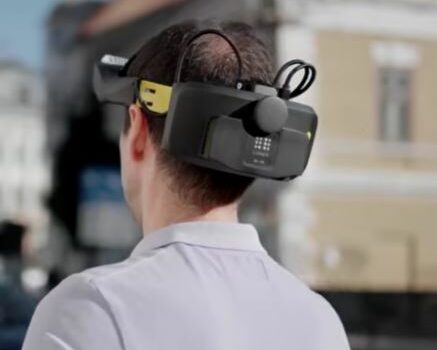
‘Self-driving’ headset to help blind people
.lumen, a Romanian deep-tech start-up, has developed innovative, AI-powered, smart ‘glasses for the blind’ using technology similar to that of a self-driving car.
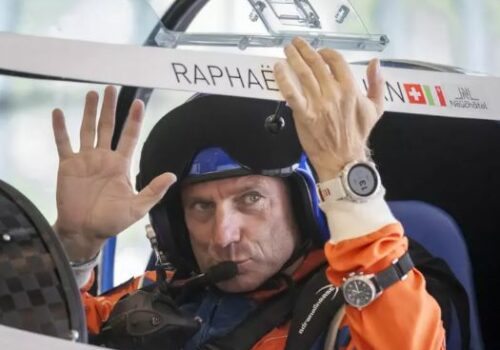
New solar-powered, plane altitude record
In August 2025, Swiss pilot Raphael Domjan beat the altitude record for a solar-powered electric plane in a flight that took him soaring to 9,521 metres.
SHORT STORY
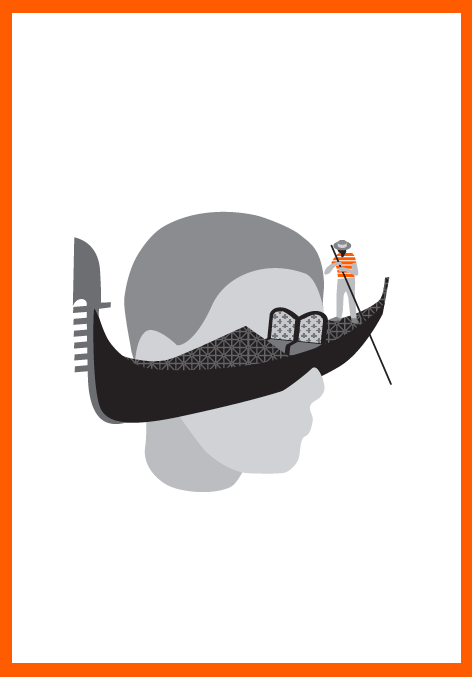
Travel memories
What if tomorrow, we travelled to the ends of the earth while staying at home?